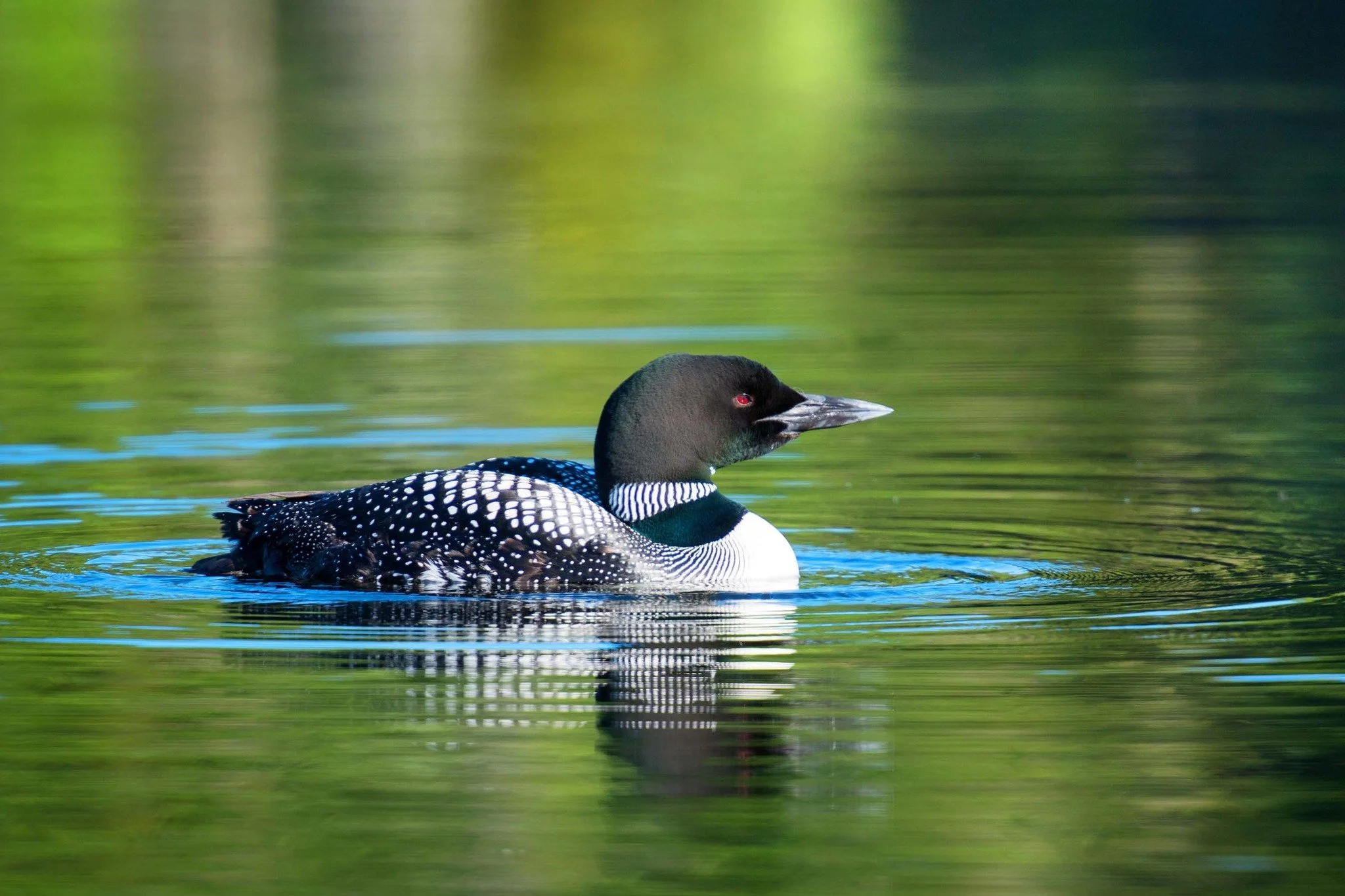
The Loons of Crystal Lake
Our loons bring so much joy and wonder to Crystal Lake! This page is your friendly go-to for everything loon-related—updates, photos, helpful guidelines, and resources to keep our loons safe and thriving. Join us in celebrating and protecting these beloved residents of our lake community!
Click to learn more → Loon Sounds - Loon Behavior - Loon Protection - Loon Activity Report
Common Sounds of Loons
The eerie call of the common loon is instantly recognizable and a cherished sound on our lake. Loons use several distinct calls, each with a specific meaning:
Wail: A long, plaintive call used to communicate over distance, often between mates or family members.
Hoot: A soft, short contact call used when loons are close together, helping them maintain contact without drawing attention.
Yodel: A louder, territorial call given by males to warn other loons to keep away from their nesting area.
Tremolo: A wavering, nervous-sounding call used to signal alarm or to express agitation—often heard when a loon senses a threat.
Cooing (or peent): A gentle, low call used between mates and parents and chicks, especially during close interactions.
These calls can serve as warnings, alerts to danger, signals to locate family, or territorial declarations. At dusk, listen for the “circle call” (often part of their wail or tremolo sequences) as loons try to locate one another while darkness settles in.
The Loon Preservation has compiled an excellent reel demonstrating each call — a great resource if you’d like to learn to identify them by ear.
Loon Behavior
At Crystal Lake you may see loons displaying a variety of behaviors and postures, including:
Preening
Bathing
Defensive posture
Circle dance
Foot waggle
These behaviors communicate how the loon is feeling. A loon’s wing flapping and the position of its body and neck can indicate whether it is relaxed, alert to your presence, or warning a potential challenger. For more detailed descriptions of loon behavior, please consult resources from the Loon Preservation Committee.
Help Protect Our Loons
As Spring arrives our lake community anxiously awaits the arrival of the loons. There are things that we can do to ensure their safety.
Check your tackle box for lead weights. If ingested they are the leading cause of death in the loon population..
There will be signs marking the nesting location, whether it’s the floating nest or somewhere near the shoreline. These signs are to ward people away, NOT to draw you near, so keep your distance. Know that if the loon feels threatened it will leave the nest. The egg is now vulnerable to the elements or to predators and may not survive.
Updates, if any, will be shared on this webpage!
As summer approaches there’s always excitement with the arrival of a chick (if we’re lucky)! Whether on the water or near the nest, if you’re getting too close, the nervous parents will alert you, be mindful of the behavior.
Later as the chick grows the parents will take turns with teachingskills to the young one: to fish, dive, to call and eventually to fly.
Sometimes, when there’s a lot of loud warning cries from the loons, look to the sky, and most likely you will see an eagle.
It’s not unusual to have other loons stop in for a visit, they are social. But the visit from another loon could also be a territory challenge. Females will challenge females and males will challenge males! The size of a lake will determine the size of the population that’s sustainable.
As the summer winds down and there’s a chill to the air, the male will take flight for his winter destination leaving the mother and now juvenile behind. Eventually too, the mother will head out and then the lake residents watch with concern the juvenile, hoping for it’s departure before the arrival of the ice.
If at anytime you feel that a loon is sick or vulnerable reach out to the Loon Preservation and alert them to the situation.
Contact link for Loon Preservation Committee

Loon Activity on Crystal Lake - June 2026
-
Loons arrived - March 30th
Our nesting pair of Loons arrived around the week of ice out this year. Several other types of waterfowl were also seen right around “ice out” including green winged teal ducks, bufflehead ducks, merganser Ducks were also reported.
-
Loon Update - May 11th
People have observed that there are three loons that have returned to Crystal Lake this year. The best way to keep them safe is to stay back and give them space. Learn their behaviors and calls, using the sections above.
-
We have a pair of nesting loons! - May 27th
We have some exciting news to share... We now have a pair of nesting loons! It's early yet, but fingers crossed for a healthy chick or two. We as humans are a big part of the success equation going forward. Signs have been put up and are intended to keep us all away from the nest. Human nature on the other hand makes us want to get a peek and perhaps a quick pic or two. This can be extremely detrimental to the incubation process. If we get too close, even with the best of intentions, we may freak out momma loon. This can lead to her vacating the nest leaving it vulnerable to predators.
-
Loon Activity June 2026
The loons’ first nest failed; no egg was found after they abandoned it, likely due to a predator. Last week they re‑nested in the same spot. Signs are back asking people to give the loons 75 yards of space. Let’s hope for a good outcome.